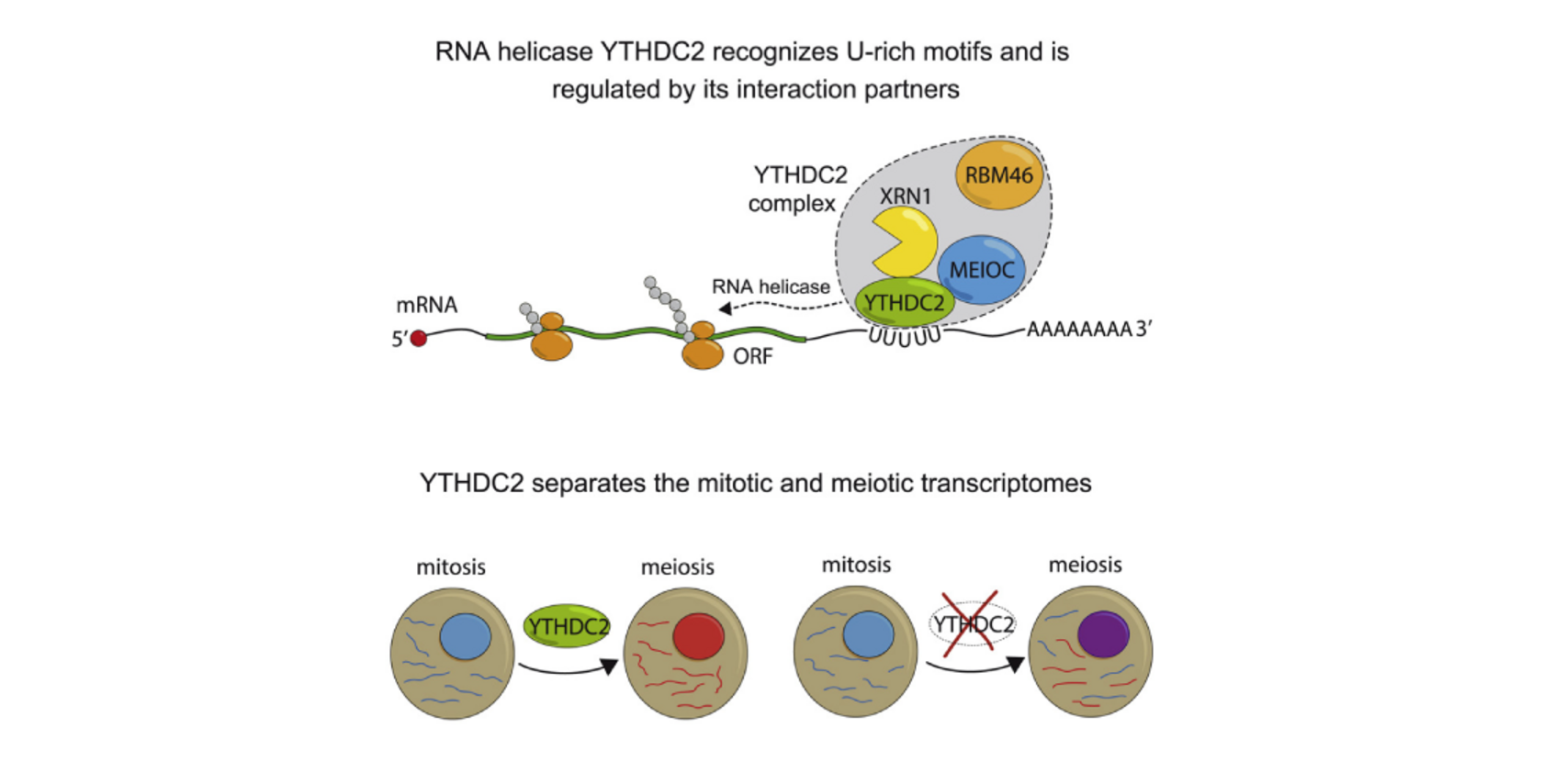
The Pillai lab investigated the role of the YTH domain containing protein YTHDC2 in mouse development. They found that YTHDC2 preferentially binds to poly-U sequences without enrichment of m6A sites in their proximity. Furthermore, mice without a functional YTH domain were viable and fertile. In contrast, mice carrying a helicase dead version of YTHDC2 were infertile like the knock-out. Also, the RNA exonuclease XRN1 enhances the RNA helicase activity of YTHDC2. Their findings were published in Molcecular Cell in the article entitled "The XRN1-regulated RNA helicase activity of YTHDC2 ensures mouse fertility independently of m6A recognition ".
Highlights:
- m6A-reading capacity of YTHDC2 is not essential for mouse fertility
- YTHDC2 binds U-rich motifs in 3? UTR of mRNAs
- The essential RNA helicase activity of YTHDC2 is enhanced by XRN1
- Ythdc2 mutant germ cells have a mixed mitotic-meiotic identity
Abstract:
The functional consequence of N6-methyladenosine (m6A) RNA modification is mediated by "reader" proteins of the YTH family. YTH domain-containing 2 (YTHDC2) is essential for mammalian fertility, but its molecular function is poorly understood. Here, we identify U-rich motifs as binding sites of YTHDC2 on 3' UTRs of mouse testicular RNA targets. Although its YTH domain is an m6A-binder in vitro, the YTH point mutant mice are fertile. Significantly, the loss of its 3'>5' RNA helicase activity causes mouse infertility, with the catalytic-dead mutation being dominant negative. Biochemical studies reveal that the weak helicase activity of YTHDC2 is enhanced by its interaction with the 5'>3' exoribonuclease XRN1. Single-cell transcriptomics indicate that Ythdc2 mutant mitotic germ cells transition into meiosis but accumulate a transcriptome with mixed mitotic/meiotic identity that fail to progress further into meiosis. Finally, our demonstration that ythdc2 mutant zebrafish are infertile highlights its conserved role in animal germ cell development.
Read the Publication in Molecular Cell (Open Access)
Abstract, figure and title from Li, Krasnykov et al. (2022) Molecular Cell published under a CC BY 4.0 license.