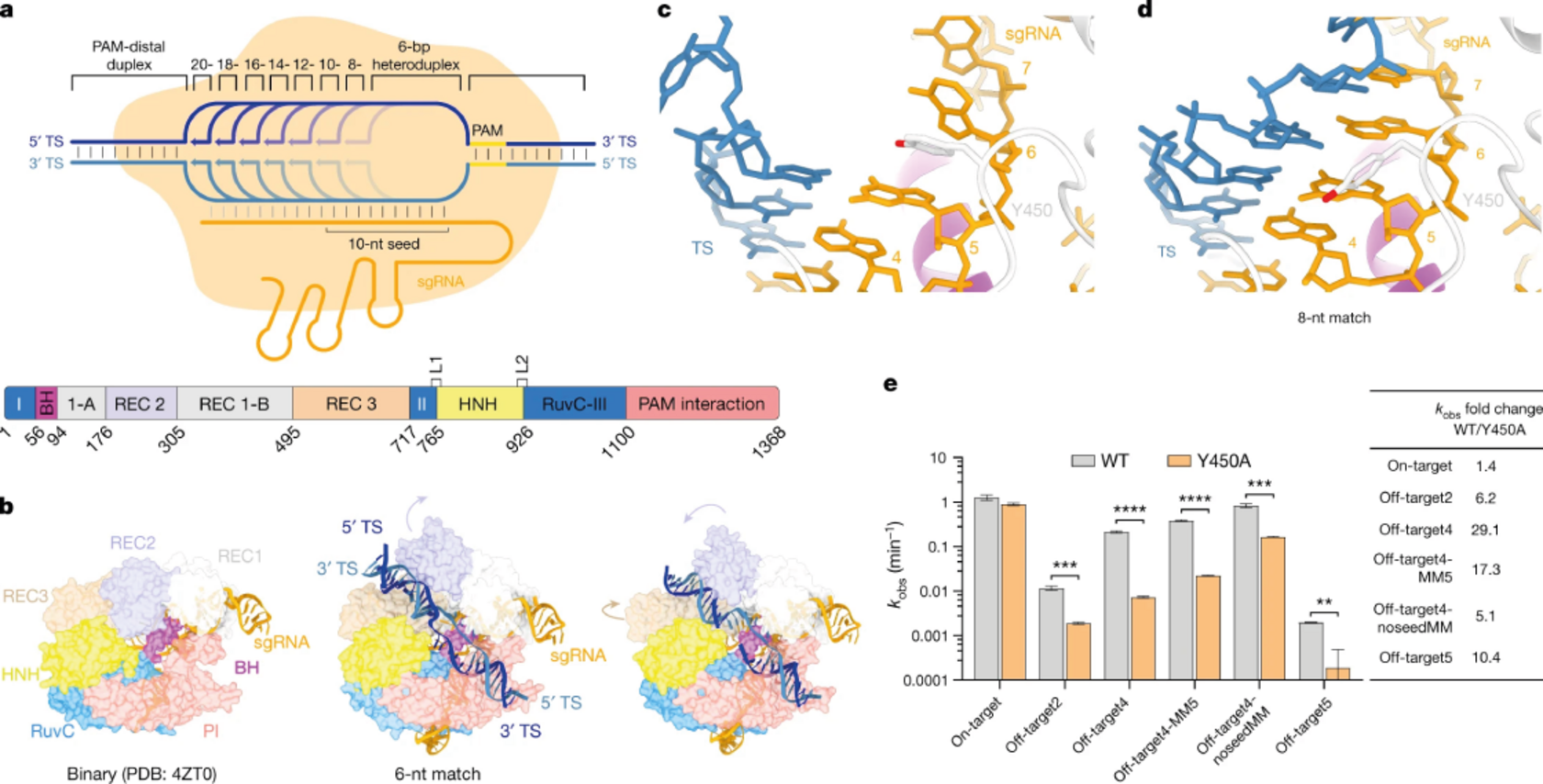
The mechanism by which CRISPR Cas9 recognizes a target site and subsequently gets activated has not been understood in detail. The Jinek lab could now shed further light on this process by a series of Cryo-EM structures capturing different stages of this process. Their findings should also help in enhancing the activity and specificity of the CRISPR Cas9 system. Their publication "R-loop formation and conformational activation mechanisms of Cas9" was published in Nature.
Abstract
Cas9 is a CRISPR-associated endonuclease capable of RNA-guided, site-specific DNA cleavage. The programmable activity of Cas9 has been widely utilized for genome editing applications, yet its precise mechanisms of target DNA binding and off-target discrimination remain incompletely understood. Here we report a series of cryo-electron microscopy structures of Streptococcus pyogenes Cas9 capturing the directional process of target DNA hybridization. In the early phase of R-loop formation, the Cas9 REC2 and REC3 domains form a positively charged cleft that accommodates the distal end of the target DNA duplex. Guide-target hybridization past the seed region induces rearrangements of the REC2 and REC3 domains and relocation of the HNH nuclease domain to assume a catalytically incompetent checkpoint conformation. Completion of the guide-target heteroduplex triggers conformational activation of the HNH nuclease domain, enabled by distortion of the guide-target heteroduplex, and complementary REC2 and REC3 domain rearrangements. Together, these results establish a structural framework for target DNA-dependent activation of Cas9 that sheds light on its conformational checkpoint mechanism and may facilitate the development of novel Cas9 variants and guide RNA designs with enhanced specificity and activity.
Read the Publication in Nature (Open Access)
Abstract, figure and title from Pacesa et al. (2022) Nature published under a CC BY 4.0 license.