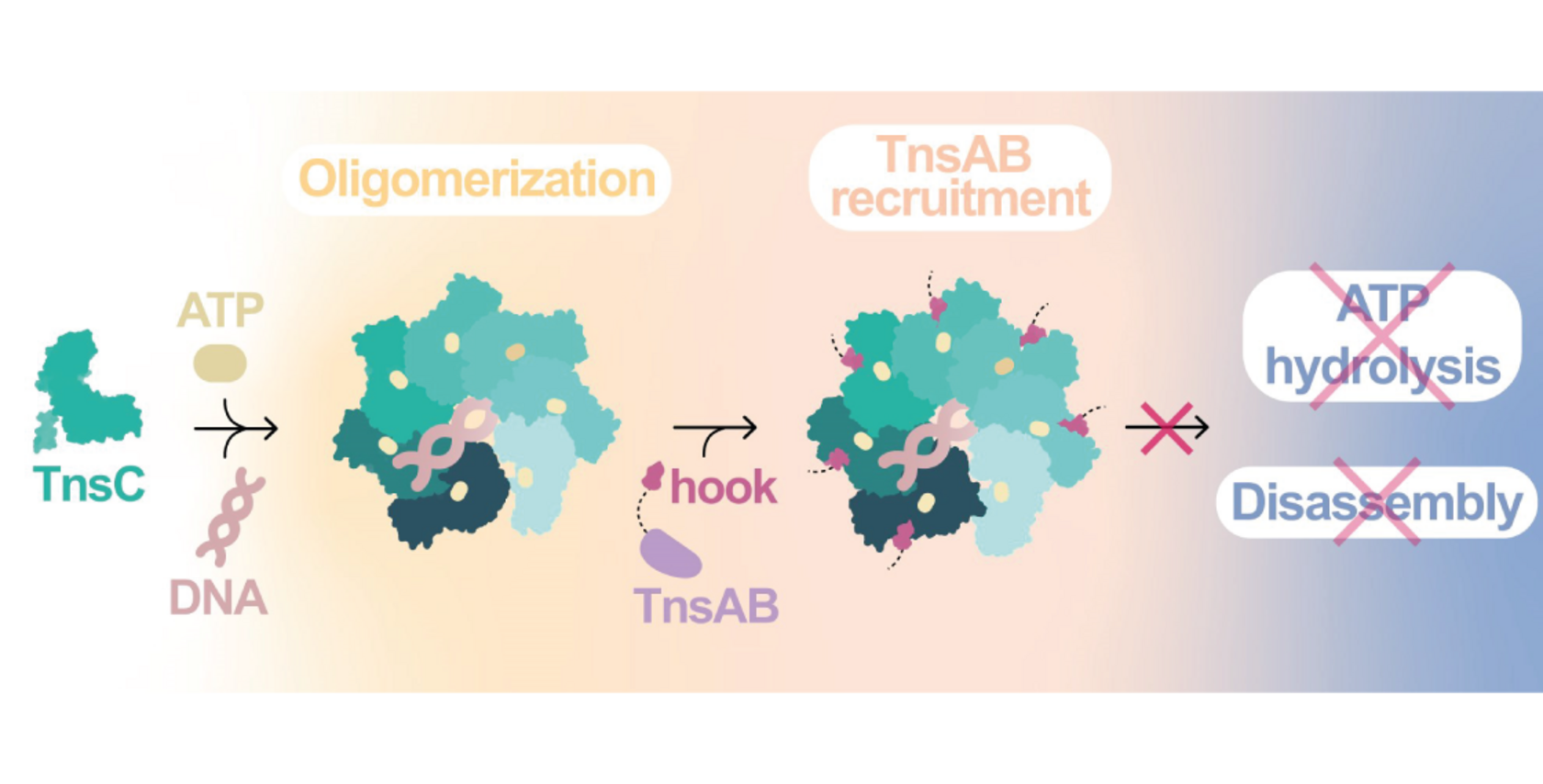
CRISRP-associated transpososon (CAST) systems can be used as genetic engineering tools to insert site-specifically large DNA sequences. Of the CAST systems, the type 1 systems have favourable properties to be used for genetic engineering. For their transposase activity, they rely on the essential interaction between the ATPase TnsC and the transposase TnsAB, which had not been studied at a detailed molecular level. The Jinek lab could now shed insights on this interaction which involves the TnsAB C-terminal tail, which serving as a hook attaches to a previously formed heptamer of TnsC. Their findings have been published in the article "Structural basis of TnsC oligomerization and transposase recruitment in type I-B CRISPR-associated transposons" in Nucleic Acids Research.
Abstract
CRISPR-associated transposon (CAST) systems employ CRISPR-Cas systems as RNA-directed targeting modules for site-specific transposon DNA insertion. Among them, type I CASTs rely on the coordinated action of the guide RNA-bound Cascade complex and the transposon proteins TniQ, TnsC, and TnsAB. The interaction between the transposase TnsAB and the ATPase TnsC is crucial for transposition activity, yet the underlying molecular details have remained elusive. Here, we investigate the type I-B CAST system from Peltigera membranacea cyanobiont. Cryo-electron microscopic structures of TnsC and its complex with the C-terminal region of TnsAB reveal that TnsC forms a heptameric ring that recruits TnsAB by interacting with its C-terminal tail. In vitro binding assays indicate that TnsAB exclusively interacts with the TnsC heptamer without inducing its disassembly, in contrast to type V-K CAST systems. Mutational analysis of key structural features corroborates the significance of TnsC multimerization and TnsB interaction for transposon activity in vivo. Altogether, these findings offer detailed structural and functional insights into the molecular mechanism of type I-B CAST, with the aim of facilitating their development as genome engineering tools.
Read the Publication in Nucleic Acids Research (Open Access)
Abstract, figure and title from Finocchio et al (2025) Nucleic Acids Res published under a CC BY-NC 4.0 license.