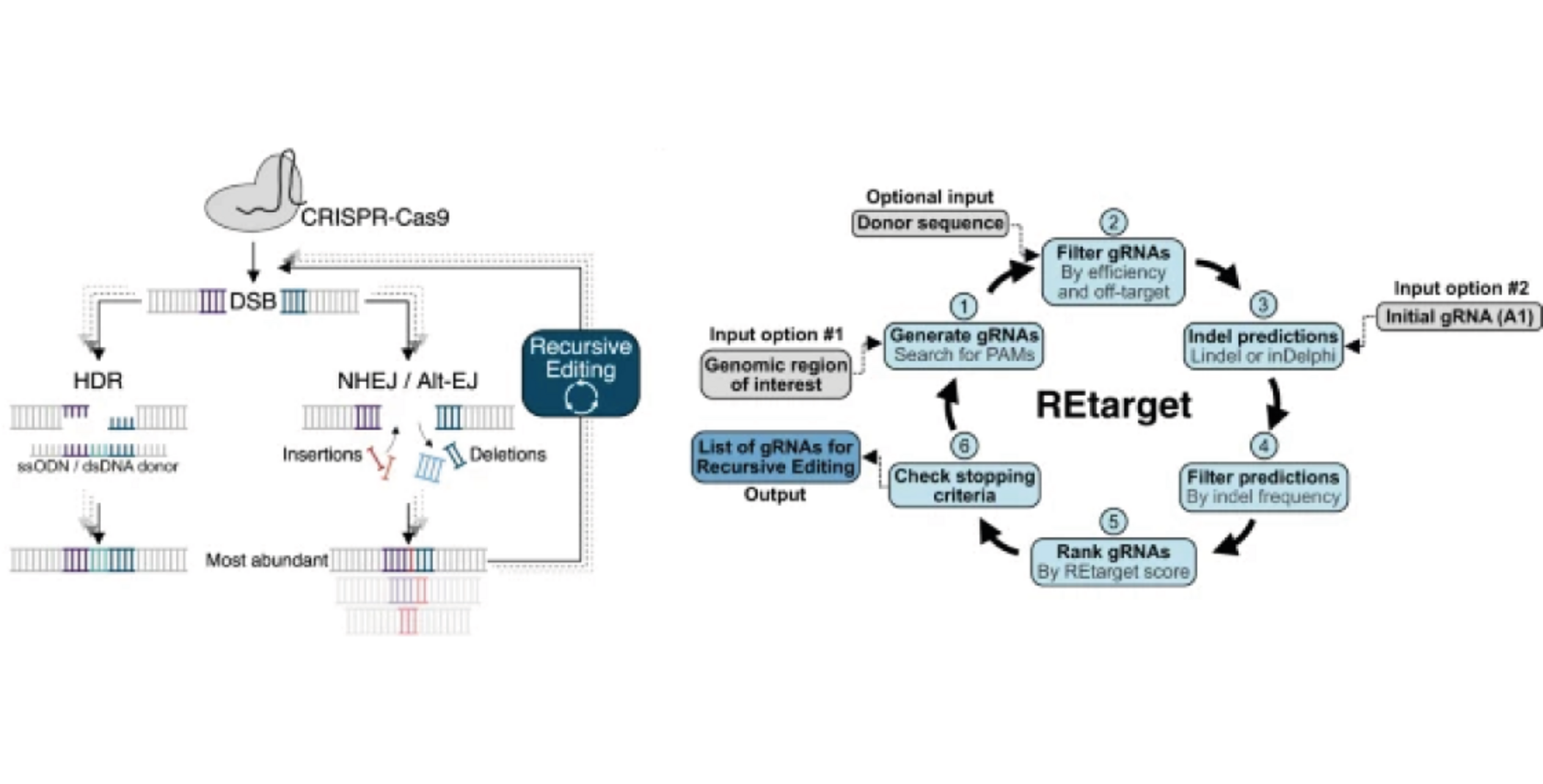
To cut genomic DNA and paste from a donor CRISPR-Cas genome editing, requires homolog-directed repair (HDR), but the efficiency of this process can be low in human cells and instead end joining pathways create short insertions and deletions. To increase the frequency of the desired HDR outcome & simultaneously reduce the undesired edits, the Corn lab (ETH Zurich) developed a method based on retargeting the short insertions & deletions for HDR editing. To faciliate the design of recursive editing experiments, they created a software tool called "REtarget" and also used it to created a database of genomic sites which should be particularly effective for recursive editing. Their method has been published in Nature Communations in the article "Recursive Editing improves homology-directed repair through retargeting of undesired outcomes".
Abstract
CRISPR-Cas induced homology-directed repair (HDR) enables the installation of a broad range of precise genomic modifications from an exogenous donor template. However, applications of HDR in human cells are often hampered by poor efficiency, stemming from a preference for error-prone end joining pathways that yield short insertions and deletions. Here, we describe Recursive Editing, an HDR improvement strategy that selectively retargets undesired indel outcomes to create additional opportunities to produce the desired HDR allele. We introduce a software tool, named REtarget, that enables the rational design of Recursive Editing experiments. Using REtarget-designed guide RNAs in single editing reactions, Recursive Editing can simultaneously boost HDR efficiencies and reduce undesired indels. We also harness REtarget to generate databases for particularly effective Recursive Editing sites across the genome, to endogenously tag proteins, and to target pathogenic mutations. Recursive Editing constitutes an easy-to-use approach without potentially deleterious cell manipulations and little added experimental burden.
Read the Publication in Nature Communications (Open Access)
Abstract, figure and title from Möller et al. (2022) Nature Communications published under a CC BY 4.0 license.